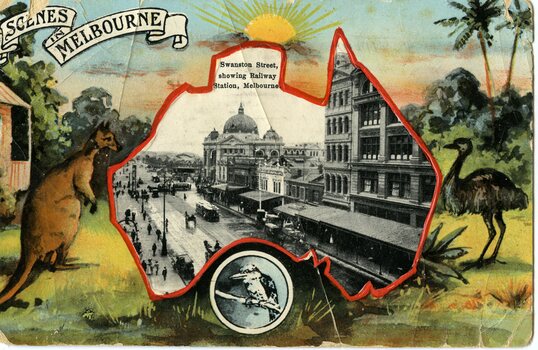
Postcard, Swanston St Melbourne, showing Flinders St station, 1913

Melbourne is a young city. Founded in 1835 Melbourne is now just shy of 200 years old. Despite this, a great deal of Melbourne's heritage has already been lost. The story begins with the discovery of gold near Ballarat in 1851 which made the state of Victoria and its capital very rich. Many high Victorian buildings were built but then in the 1890s the bubble burst, Australia went into a depression and many financial institutions and speculative developers went under. Two decades later in 1901 Melbourne became the centre of government for a fledgling nation and the city wanted to be seen as forward looking. Two world wars and another depression kept a lid on Melbourne's ambitions, then in 1949 Melbourne was announced as the host city for the Games of the XVI Olympiad (1956). Again the city wanted to be seen as a modern metropolis so it was decided to demolish a number of Melbourne's older buildings. Unfortunately, it wasn't till the mid-to-late 1970's that Melbourne began to appreciate its history and what had been lost. The detailed story of Melbourne’s mad pursuit of modernity has been reported often. Bloggers, social media denizens and scholars have written about it, books published and documentaries filmed. However, the idea of this site is to plot this history so the link between past and present are made visible.

Here the map is centred on the old Victorian Post Office (now a “retail experience”) and it extends just beyond the Hoddel Grid.

Locating some places on a present-day map accurately has been a challenge as, over time the streets of Melbourne have been changed, renamed, renumbered and some no longer exist.

The buildings and other objects included here have all been lost to history or significantly altered over time. Everything from the humble “Old Tin Shed” to high Victorian Coffee Palaces are included, but not the survivors which are equally interesting but can be seen by visiting Melbourne today. Not all losses are from the mid to late nineteenth century and not all will be missed. Several examples of mid twentieth century modernist architecture have come and gone in less time than their C19th counterparts and some, like the Gas and Fuel Corp. buildings, were a blight on the city anyway.

Got questions, ideas, or something to share? Pop over to the lostmelbourne.city facebook page lostmelbourne.city is on facebook

Acknowledgement of Country

​​​​​​The authors of this website respectfully acknowledges the Traditional Owners of the land on which the City of Melbourne resides, the Wurundjeri Woi-wurrung and Bunurong / Boon Wurrung peoples of the Kulin and pays respect to their Elders past and present. We acknowledge and honour the unbroken spiritual, cultural and political connection they have maintained to this unique place for more than 2000 generations.
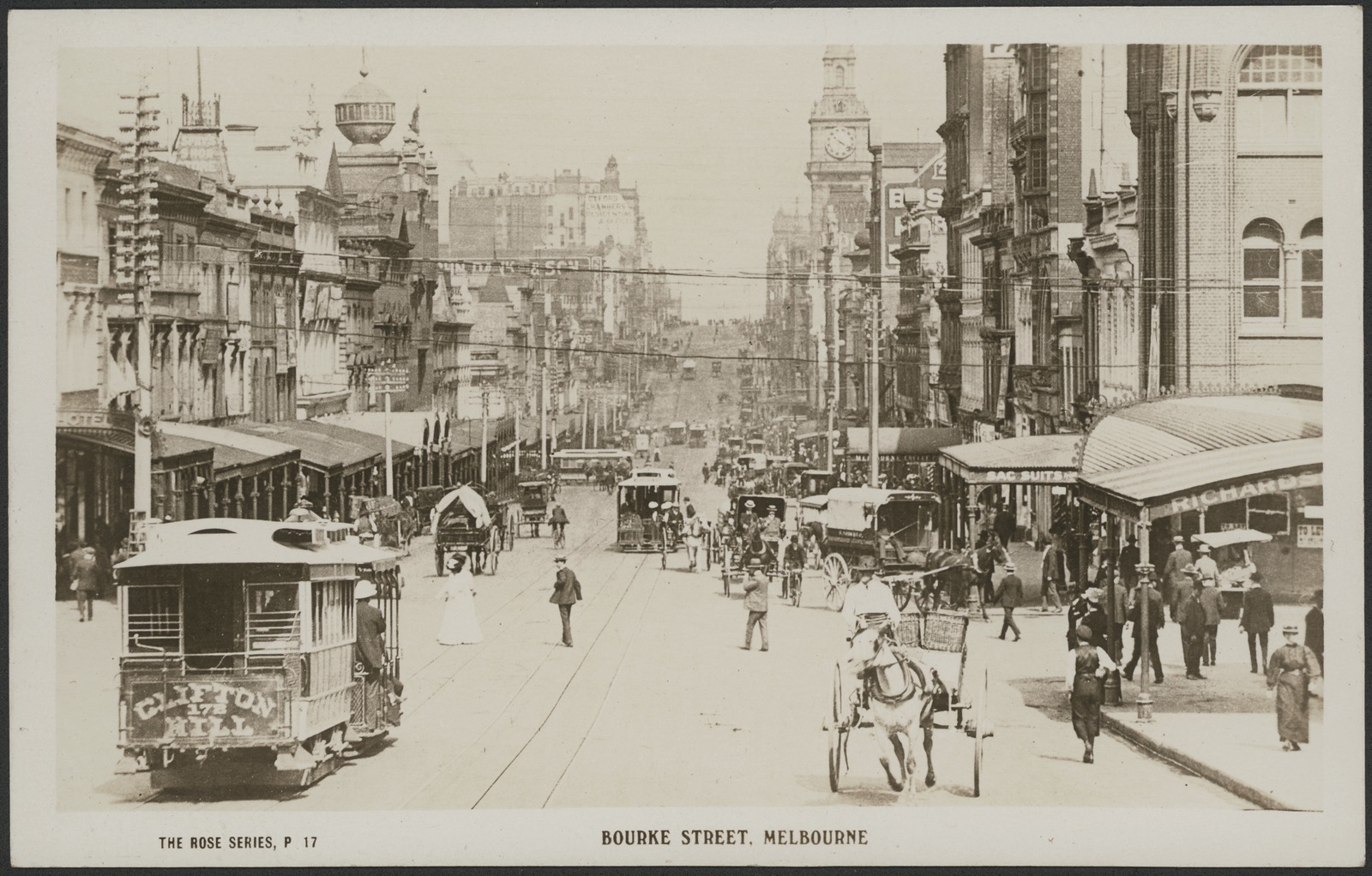
Bourke Street, Melbourne C1900 Rose Stereograph Co., photographer

Lost Melbourne City wishes to acknowledge the individuals and organisations that have made this website possible.

Bibliography

Annear, R. (2014) A City Lost and Found: Whelan the Wrecker’s Melbourne. Melbourne: Black Inc.
Annear, R. (2021) Adrift in Melbourne: seven walks with Robyn Annear / Robyn Annear. Wurundjeri Country ; The Text Publishing Company. Available at: https://www.textpublishing.com.au/books/adrift-in-melbourne.
Australian Food Timeline, Australian Food Timeline. Available at: https://australianfoodtimeline.com.au/.
Australian Variety Theatre Archive, Australian Variety Theatre Archive. Available at: https://ozvta.com/.
Australian War Memorial. Available at: https://www.awm.gov.au/advanced-search.
Berger, G. (2023) The Lost City of Melbourne: This Is a Story of Marvellous Melbourne, Before Whelan the Wrecker Was Here / Gus Berger. Victoria: Gusto Films.
Broome, R. (2016) Remembering Melbourne 1850-1960. Melbourne, Vic.: Royal Society Society of Victoria Inc. Available at: https://www.historyvictoria.org.au/product/remembering-melbourne-1850-1960-by-richard-broome-richard-barnden-don-gibb-don-garden-elisabeth-jackson-and-judith-smart/.
Cain, J. Map Collection - University of Melbourne. University of Melbourne Information Division. Available at: https://maps-collection.library.unimelb.edu.au/historical/1945melb/.
Cinema Treasures. Available at: https://cinematreasures.org/.
City Collection - City of Melbourne, City Collection. Available at: https://citycollection.melbourne.vic.gov.au/.
eMelbourne - The Encyclopedia of Melbourne Online, Encyclopedia of Melbourne. Document. School of Historical Studies<br /> Department of History, The University of Melbourne. Available at: https://www.emelbourne.net.au/index.html.
Explore Museums Victoria’s humanities and natural sciences collections, Museums Victoria Collections. Available at: https://collections.museumsvictoria.com.au.
ISBN 9781922459206 - Adrift In Melbourne. Available at: https://isbnsearch.org/isbn/9781922459206.
Lost Melbourne - Facebook. Available at: https://www.facebook.com/LostMelbourne.
Macheras, C. (2021) Old Vintage Melbourne. Carlton North, VIC: Scribe Publications. Available at: https://scribepublications.com.au/books-authors/books/old-vintage-melbourne-9781922310941.
Macheras, C. (2023) Old Vintage Melbourne 1960-1990. Carlton North, VIC: Scribe Publications. Available at: https://scribepublications.com.au/books-authors/books/old-vintage-melbourne-1960a1990-9781922585691.
Melbourne Tram Museum. Available at: https://www.hawthorntramdepot.org.au/index.htm.
Peter Andrew Barrett - Facebook. Available at: https://www.facebook.com/profile.php?id=100045427796115.
Photowall | PROV. Available at: https://prov.vic.gov.au/photowall.
Places to visit - National Trust, National Trust. Available at: https://www.nationaltrust.org.au/places-vic/.
Promoting & preserving the history of Victoria, Royal Historical Society of Victoria. Available at: https://www.historyvictoria.org.au/.
Retro Melbourne (2014). London: New Holland. Available at: https://au.newhollandpublishers.com/retro-melbourne-9781742575797.html.
Search & discover - State Library Victoria, State Library Victoria. Available at: https://www.slv.vic.gov.au/search-discover.
State Library Victoria The streets of Melbourne – by numbers (2013). Available at: https://blogs.slv.vic.gov.au/such-was-life/the-streets-of-melbourne-by-numbers/.
Storey, R. (2024) Storey of Melbourne, Storey of Melbourne. Available at: http://storeyofmelbourne.wordpress.com.
The Bloodied Wombat. Available at: http://bloodiedwombat.heritagenetworkvic.com.au/.
The Museum of Lost Things (2024), The Museum of Lost Things. Available at: https://www.museumoflost.com/.
The old tin shed (2018). Available at: https://blogs.slv.vic.gov.au/such-was-life/the-old-tin-shed/.
Trove - National Library of Australia, Trove. Available at: https://trove.nla.gov.au/.
Victorian Collections, Victorian Collections. Available at: https://victoriancollections.net.au/.
Victorian Heritage Database, Victorian Heritage Database. Available at: https://vhd.heritagecouncil.vic.gov.au/.
Victorian Places. Available at: https://www.victorianplaces.com.au/.
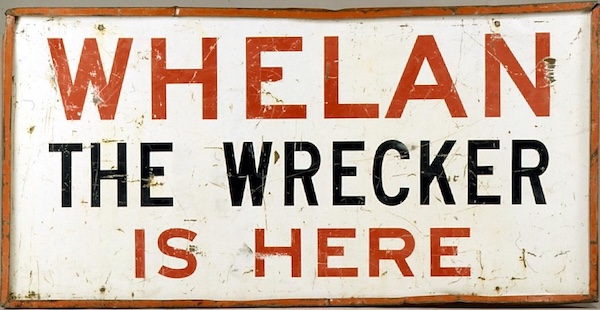
The legendary 'Whelan The Wrecker Is Here' sign, now in the collection of Museums Victoria
NameImageAddressDescriptionArchitectBuilt/Est.Demolished

Key

[AI] = Description produced with the assistance of ChatGPT.

×